
Introduction
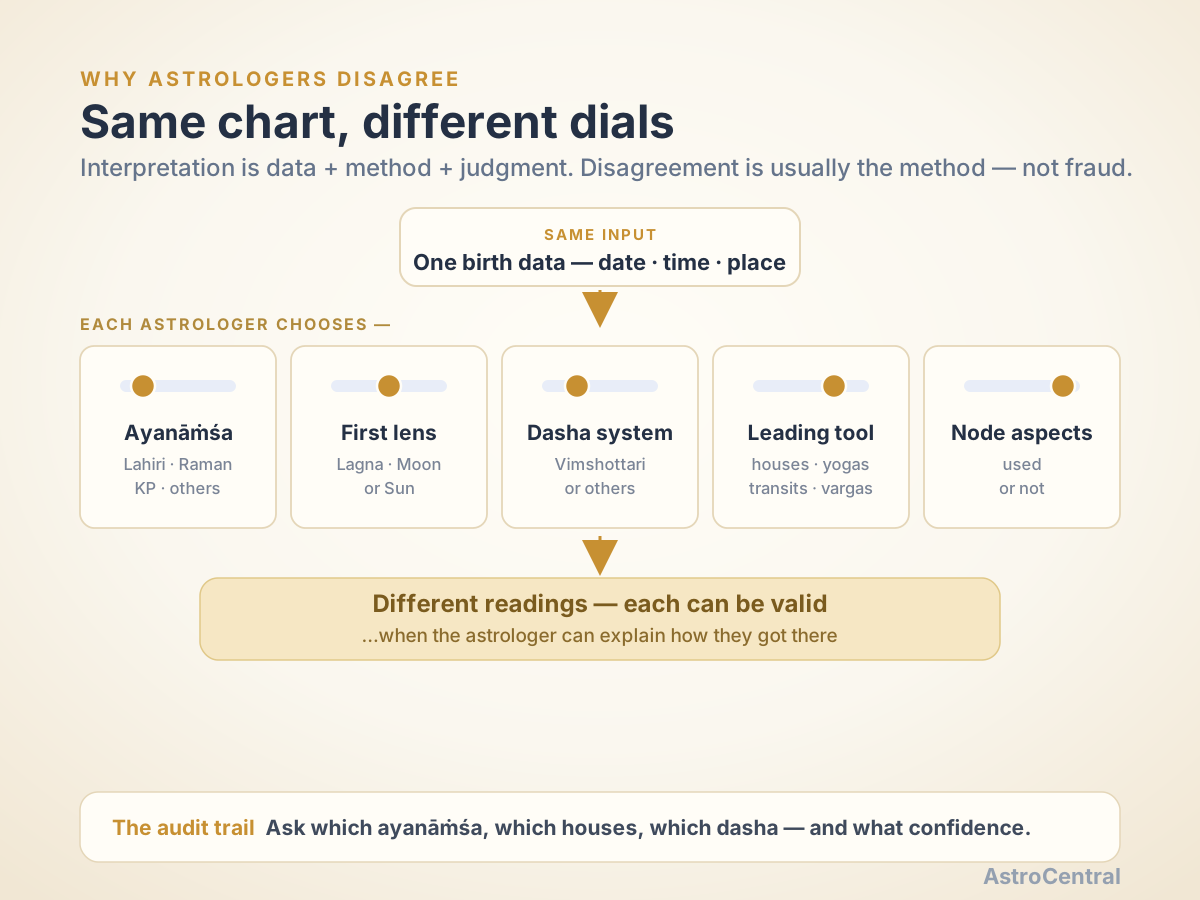
Two astrologers can look at the same birth data and give different readings. One emphasizes the Moon. Another starts with Lagna. One focuses on dasha. Another spends more time on transits or divisional charts.
That can feel suspicious if you expect astrology to behave like a single calculator. But chart interpretation is not only data. It is data plus method plus judgment.
The real trust question is not "Do they agree on every sentence?" It is "Can they explain how they got there?"
Plain-English Explanation
A chart contains many layers: signs, houses, planets, aspects, nakshatras, dashas, yogas, strengths, and divisional charts. An astrologer chooses which layer answers the question best.
Different schools also use different conventions. Some practitioners give Rahu and Ketu special aspects; others avoid that. Some emphasize one ayanamsha; others use another. Some read from Lagna first, some from Moon, and some compare both.
What Most People Get Wrong
The popular mistake is assuming disagreement means fraud. Sometimes it does reveal carelessness. Often it reveals different assumptions.
A responsible astrologer should be able to say: "I am using this ayanamsha, this house approach, this dasha system, and this level of confidence." That transparency matters.
How To Check It In Your Chart
When comparing two readings, ask:
- Are they using the same birth time and location?
- Are they using the same zodiac and ayanamsha?
- Are they reading from Lagna, Moon, Sun, or all three?
- Which dasha system are they using?
- Are they considering strength, cancellation, and full-chart context?
- Are they using responsible language for sensitive topics?
This turns confusion into an audit trail.
What It May Mean In Real Life
One astrologer may describe your career through the 10th house and 10th lord. Another may focus on the running dasha. A third may notice Saturn's influence and discuss discipline, delay, or long-term development.
These readings can all contain useful pieces. The better question is whether they fit the chart and the life context without pretending to be certainties.
What Not To Conclude Too Quickly
Do not accept frightening claims just because they sound technical. Health, money, marriage, fertility, and longevity topics need careful framing, consent, and humility.
Astrology is a screening tool, not a verdict. The human being is larger than the technique.
Practical Application
Before a reading, write your own method checklist:
- Chart settings visible?
- Birth time reliability stated?
- Main question defined?
- Dasha and transit context separated?
- Sensitive claims framed as potential, not guaranteed outcomes?
If a reading cannot pass that checklist, slow down.
Common Misconceptions
- One correct method should erase all others. Traditions can use different tools for different questions.
- Disagreement means nothing is real. It may mean the method choices were not made explicit.
- A dramatic prediction is deeper. Responsible interpretation is usually more conditional and more useful.
Related Concepts
- Why Vedic and Western Astrology Give You Different Sun Signs - The zodiac-reference version of this problem.
- How to Actually Read Your Kundli - How to create a clean reading order.
- What If You Do Not Know Your Exact Birth Time? - Why data quality changes confidence.
Sources & References
- Brihat Parashara Hora Shastra, Chapters 3, 4, 11, 26, 34, and 46 - core interpretive building blocks.
- content-drafts/vedic-astrology/shared/JYOTISH-REFERENCE-DATA.md - canonical tables and noted variations.
- content-drafts/CONTENT-AUTHORING-GUIDE.md - responsible language and editorial standards.
FAQ
Can two astrologers both be partly right?
Yes. They may be emphasizing different valid layers of the chart.
What should I ask when readings conflict?
Ask about chart settings, dasha system, house approach, and the reasoning behind the claim.
Is a scary prediction a sign of expertise?
No. Responsible astrologers use careful language, especially for sensitive topics.
How does AstroCentral handle disagreement?
We name the method, cite the reference where possible, and separate traditional association from guaranteed outcome.