Introduction
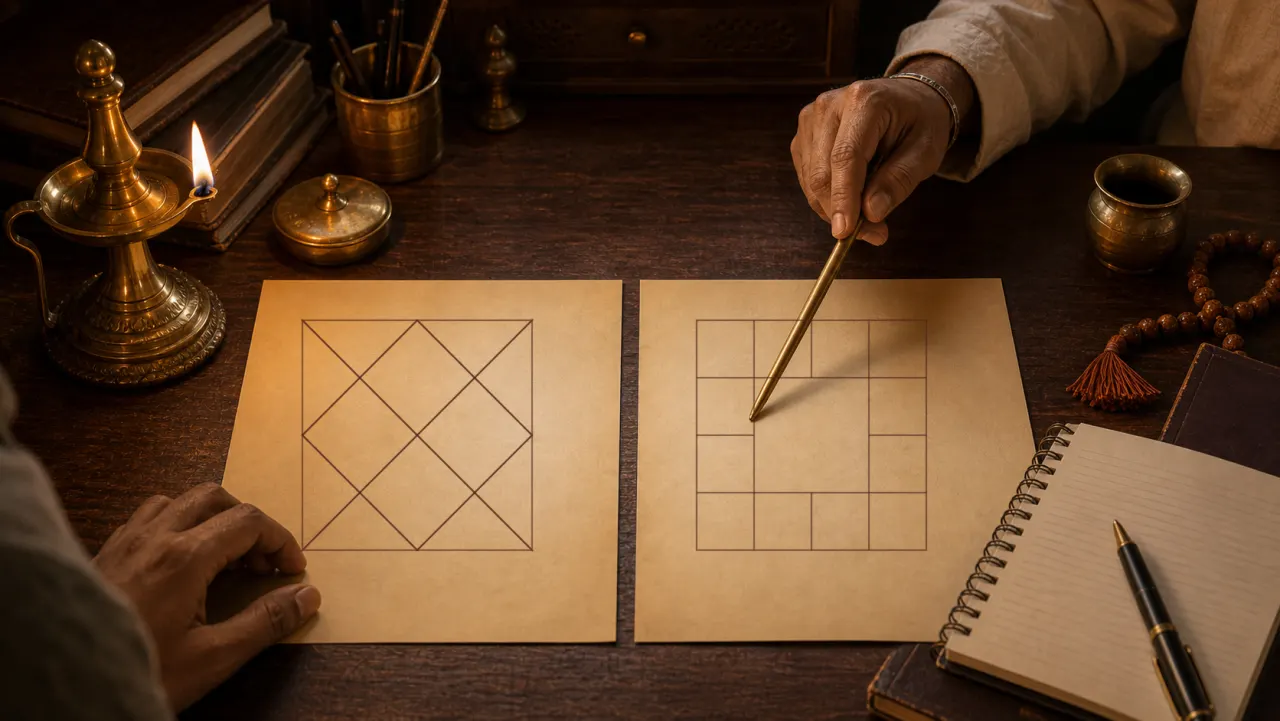
A Kundli can look like a secret code the first time you see it. Diamonds, squares, abbreviations, numbers, and planets appear in a layout that seems to assume you already know the language.
Here is the relief: the diagram is only a container. Once you know where the Lagna is, where the signs are, and where the planets sit, the chart becomes readable step by step.
This article gives you a safe first pass, not a full interpretation.
Plain-English Explanation
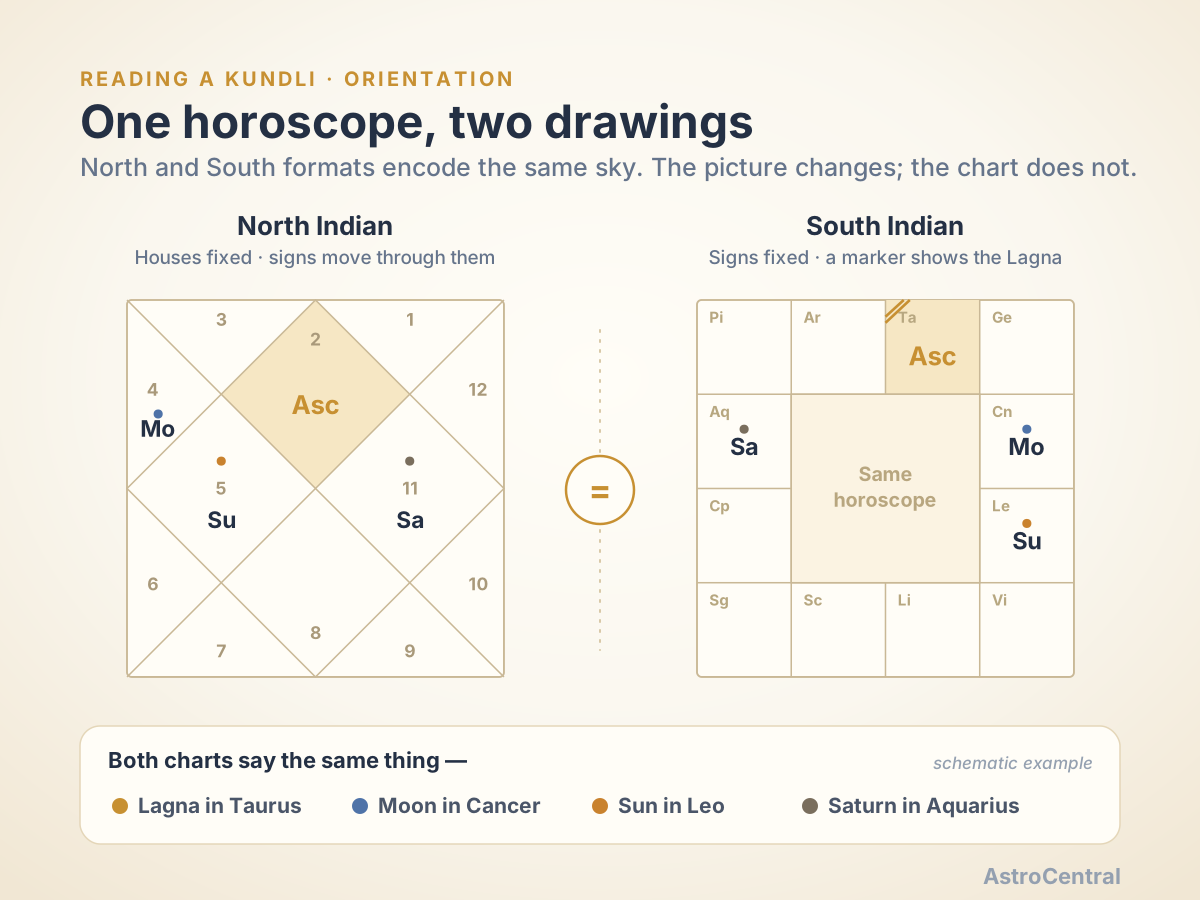
A Kundli is a birth chart. It maps the sidereal zodiac, houses, planets, and degrees for a birth moment. Different regions use different drawing styles.
North Indian charts usually keep houses fixed and move signs through them. South Indian charts usually keep signs fixed and mark the Lagna to show which sign becomes the 1st house. Software may offer both.
The data are the same when the settings match. The picture changes; the chart does not.
What Most People Get Wrong
The first mistake is reading whichever planet looks visually prominent. The second is trying to interpret everything at once.
Start with orientation. Find Lagna. Identify the house sequence. Then read one planet at a time through sign, house, lordship, dignity, and aspects.
How To Check It In Your Chart
- Confirm the chart uses a sidereal zodiac.
- Find the Lagna marker.
- Identify the sign in the 1st house.
- Count houses from the Lagna.
- Locate the Moon, Sun, and Lagna lord.
- Add house categories: Kendra, Trikona, Dusthana, and Upachaya.
- Read one question at a time.
This order prevents the chart from becoming a blur.
What It May Mean In Real Life
A Kundli is most useful when it helps you organize questions. "What is my temperament?" starts with Lagna, Moon, and Lagna lord. "What is my work pattern?" starts with the 10th house, 10th lord, Saturn, Sun, and relevant dashas.
The chart can guide inquiry. It should not replace lived experience, consent, professional advice, or practical planning.
What Not To Conclude Too Quickly
Do not treat one placement as the answer. A planet in the 7th is not a full marriage reading. A planet in the 10th is not a guaranteed career path. A difficult house is not a life sentence.
Use the chart as a screening tool, not a verdict. Good readings are layered.
Practical Application
Open your chart and fill this mini-map:
| Step | Your chart |
|---|---|
| Lagna sign | |
| Lagna lord | |
| Moon sign and nakshatra | |
| Sun sign | |
| Planets in Kendras | |
| Planets in Trikonas |
Then read Your Rising Sign (Lagna) before going deeper.
Common Misconceptions
- Chart format changes the reading. The format changes the drawing, not the underlying placements.
- You must memorize everything first. You can read with a reference table open.
- One glance reveals destiny. A chart needs context, timing, and responsible interpretation.
Related Concepts
- Your Rising Sign (Lagna) - The first anchor in the Kundli.
- Your Moon Sign Matters More Than Your Sun Sign - The next anchor to identify.
- Why Astrologers Disagree - Why settings and methods can change interpretation.
Sources & References
- Brihat Parashara Hora Shastra, Chapter 4 - zodiacal signs.
- Brihat Parashara Hora Shastra, Chapter 11 - judgement of houses.
- Brihat Parashara Hora Shastra, Chapter 24 - effects of bhava lords.
- content-drafts/vedic-astrology/shared/JYOTISH-REFERENCE-DATA.md - house categories, aspects, and sign lordships.
FAQ
Which chart format should I learn first?
Use whichever your teacher or software presents consistently. The key is understanding Lagna, signs, and houses.
Are North Indian and South Indian charts both Vedic?
Yes. They are visual formats used within Jyotish practice.
What should I read first in a Kundli?
Start with Lagna, Lagna lord, Moon, and the question you are trying to answer.
Can I read a chart without exact degrees?
You can learn the broad structure, but degrees matter for nakshatras, divisional charts, combustion, and precise timing.