Introduction
Rahu is one of the strangest ideas in Jyotish: a planet that is not a physical planet.
You cannot point a telescope at Rahu the way you can point one at Saturn. Yet in a Vedic chart, Rahu can describe some of the loudest patterns in a person's life: fascination, ambition, foreignness, taboo, technology, sudden openings, and the appetite for experience that never feels quite satisfied.
That is why Rahu needs careful language. It is not a cartoon villain in the chart. It is a shadow graha - a mathematical point with a psychological and karmic voice.
Plain-English Explanation
Rahu and Ketu are the lunar nodes. They mark the places where the Moon's path intersects the Sun's apparent path. Eclipses happen near this axis, which is one reason the nodes became so symbolically powerful in Indian astrology.
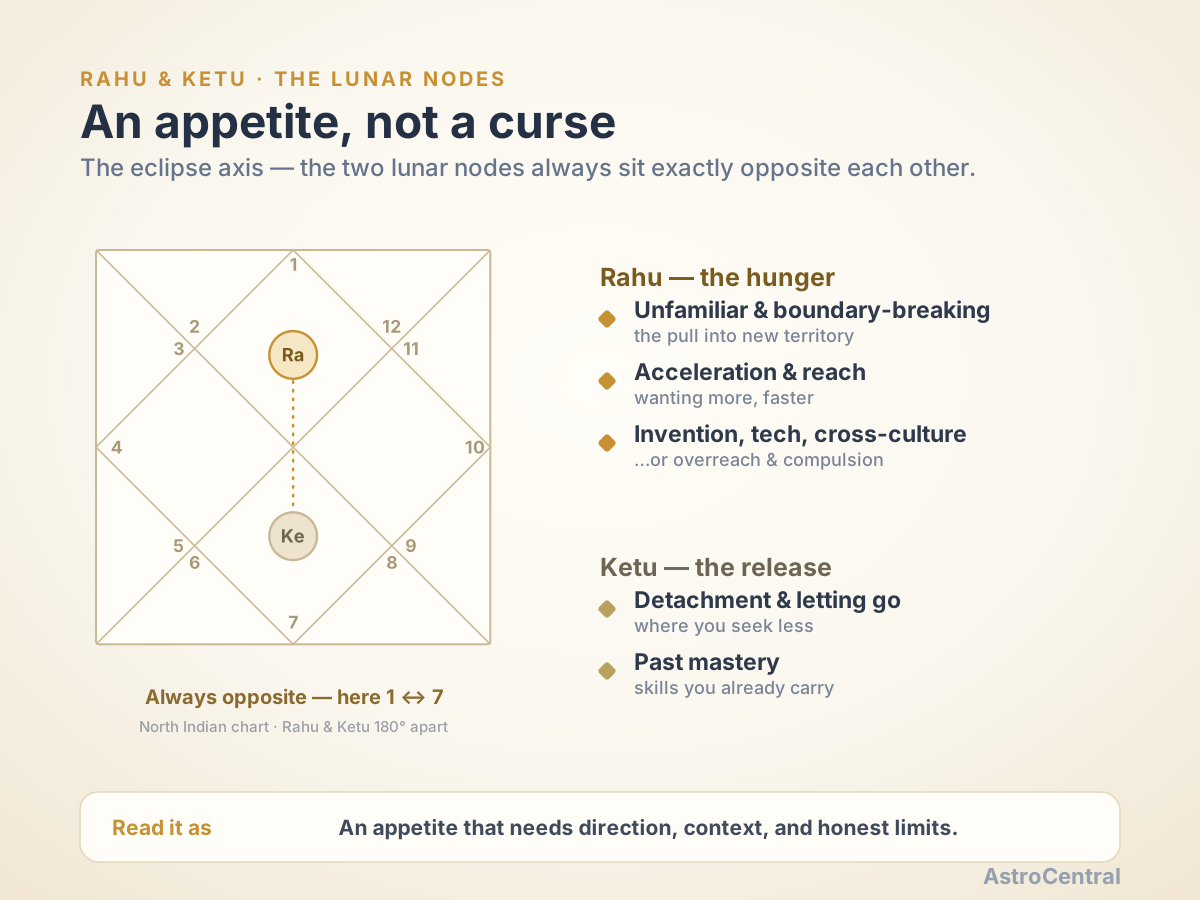
Rahu is the north node. Ketu is always opposite it. If Rahu is in the 10th house, Ketu is in the 4th. If Rahu is in Aries, Ketu is in Libra.
In interpretation, Rahu often points to the place where life feels unfamiliar, hungry, accelerated, or boundary-breaking. It can show where a person wants more experience, more recognition, more access, or more freedom from old rules.
What Most People Get Wrong
The popular shortcut is: "Rahu is bad." That shortcut misses the point.
Rahu can show confusion, compulsion, and overreach. It can also show invention, cross-cultural movement, technical skill, and the courage to enter unfamiliar territory. The difference depends on house, sign, dispositor, strength, dasha activation, and the maturity of the person living the chart.
How To Check It In Your Chart
- Find Rahu in your sidereal Vedic chart.
- Note its house and sign.
- Find Ketu directly opposite it.
- Check the lord of Rahu's sign, because Rahu expresses through that planet's condition.
- Check whether Rahu is activated by dasha, antardasha, or major transit.
- Ask which aspect convention your astrologer or software is using for the nodes.
What It May Mean In Real Life
Rahu in the 1st can point to a strong need to define oneself outside inherited expectations. Rahu in the 7th may bring unconventional relationships or attraction to people from very different backgrounds. Rahu in the 10th can show hunger for public impact, unusual career paths, or a public image that grows through disruption.
None of this is automatic. Rahu describes a pressure point. What a person does with that pressure depends on discipline, environment, choices, and timing.
What Not To Conclude Too Quickly
Do not assume Rahu ruins the house it occupies. Also do not assume it gives instant success. Rahu can magnify desire before it gives clarity.
The safest reading is: "This is an area where the person may feel pulled toward new territory." Then the chart reader checks whether that pull is supported by the rest of the horoscope.
Practical Application
Write down three Rahu questions:
- What do I chase even when I already have enough?
- Where do I feel both attracted and uncertain?
- Which area of life improves when I replace fantasy with skill?
Then compare Rahu with Ketu: The Headless Planet of Enlightenment and Letting Go when that node spoke is ready.
Common Misconceptions
- Rahu is always destructive. Rahu can disrupt, but it can also innovate.
- Rahu gives fame by itself. Fame needs 10th-house, Lagna, dasha, and public-support factors.
- All astrologers read Rahu aspects the same way. Node aspects vary by tradition, so the method should be named.
Related Concepts
- Why Two Astrologers Disagree - Useful for understanding node aspect differences.
- Rahu Mahadasha - The timing layer for Rahu themes.
- Grahan Dosha - A later node article about eclipse-style conjunctions.
Sources & References
- Brihat Parashara Hora Shastra, Chapter 25 - non-luminous planets.
- Brihat Parashara Hora Shastra, Chapter 55 - Rahu antardasha context.
- content-drafts/vedic-astrology/shared/JYOTISH-REFERENCE-DATA.md - node rulership note, aspect variation, dasha length, karaka themes.
FAQ
Is Rahu a real planet?
No. Rahu is a lunar node, not a physical planet. Jyotish still treats it as a graha for interpretation.
Is Rahu always bad?
No. Rahu may show confusion or excess, but it can also point to innovation, foreign connections, technology, and ambition.
Why is Ketu always opposite Rahu?
The nodes form one axis. The north node and south node are always opposite each other in the chart.
Should I fear Rahu mahadasha?
Fear is not a good reading strategy. Rahu periods can be intense, but the results depend on the whole chart and the choices made during that period.